In our recent Local SEO review with QTL Holdings, we didn’t want to simply report data — we wanted to tell a story.
The opening slides framed Local SEO as an ongoing journey rather than a list of tasks.
The presentation walked the client through:
Their goals: increasing visibility, GBP engagement, and local leads.
The groundwork completed in 2025.
Everything done behind the scenes to create momentum.
By starting with context, we grounded the client in why our work matters — and reminded them how far they’ve already come.
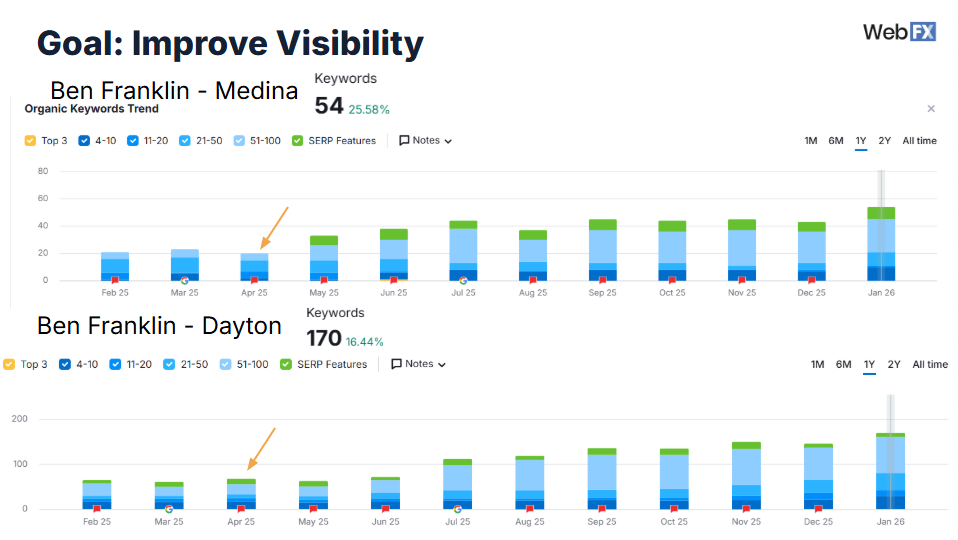
The visibility slides (Medina, Dayton, Columbus, and OHH locations) told a clear “before and after” story:
Keyword growth
Map grid visibility
Unlocking new markets
Plateau moments that needed strategic shifts
Instead of just saying, “your visibility improved,” we showed it through visuals.
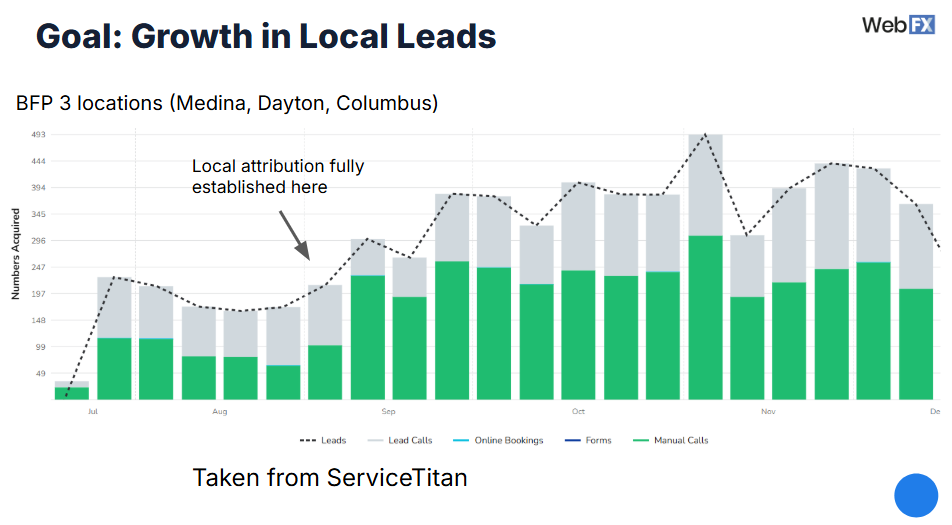
In the call, we used the ServiceTitan data to reveal a critical plot point:
Once tracking was fully established, we could finally prove that Local SEO was driving real local leads.
This is where the story became tangible:
Local attribution for 3 Ben Franklin locations
Local attribution for 2 One Hour locations
A clear timeline showing how leads increased month by month
The scheduler tool proving consistent lead flow
This transformed Local SEO from “something happening in the background” to “a proven revenue engine.”
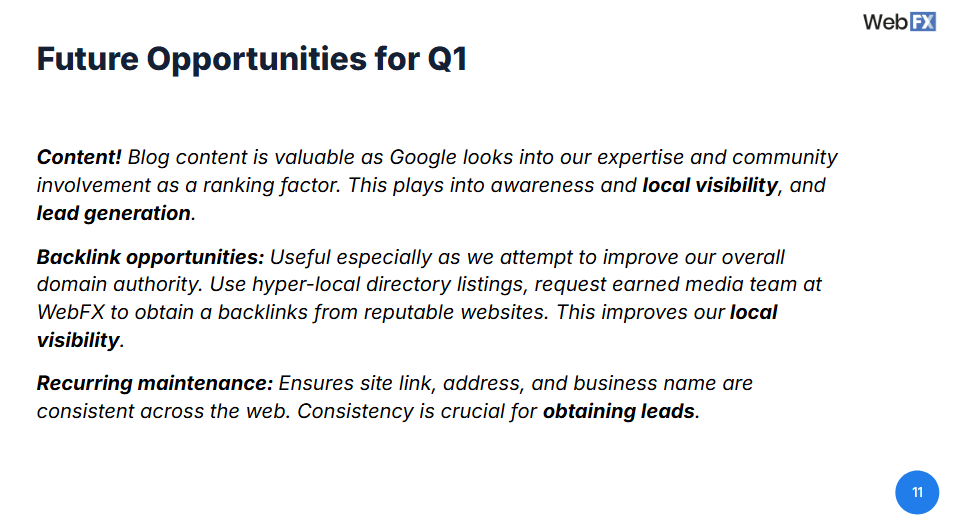
The final slides connected the story to the next phase:
New Map Grid reports
Content opportunities
Hyper-local backlink strategy
Consistent citation maintenance
Continued visibility + lead generation
This positioned 2026 as the next chapter, making the client feel like the journey is ongoing and worth investing in.
This case study shows how storytelling turns a standard SEO report into a memorable, impactful client experience.
Instead of presenting data, we presented a narrative:
Problem → Action → Proof → Growth → Next Steps
In the call, we used the ServiceTitan data to reveal that Local SEO was driving real local leads.
We also utilized screenshots of Semrush for their location pages (Medina, Dayton, Columbus, and OHH locations), which showed an improvement in local visibility with keywords.
Instead of seeing Local SEO as scattered tasks, storytelling helped them see a cohesive progression:
Where they started
What we improved along the way
How each action tied directly to visibility and leads
Why their investment matters
This transformed Local SEO from a technical concept into an understandable, relatable narrative.